
Emergency General Contractor Near Me: What Buena Park Homeowners Should Do First
When a tree limb crashes through your roof or a pipe bursts inside a wall cavity, you need a licensed emergency general contractor in Buena Park who will stabilize the damage first and quote the full repair second. The right sequence is: document everything, prevent further damage, verify the contractor’s license through CSLB, and never sign a contract under pressure. If you’re standing in water or looking at daylight through your ceiling right now, call (855) 382-0824 and we’ll walk you through the first steps over the phone.
Here’s what most Buena Park homeowners don’t realize until it’s too late: the 60 minutes after a structural emergency determines whether your insurance claim gets approved, whether your home stays protected from secondary damage, and whether you end up locked into a contract with someone who shouldn’t be touching your house. We’ve walked homeowners through this process enough times to know that the people who have a plan fare dramatically better than the people who start Googling in a panic.
The First 60 Minutes: Document Before You Touch Anything
Your insurance claim hinges on evidence, and evidence disappears fast. Water wicks into drywall. Wind-blown debris gets moved. Well-meaning neighbors start “helping” before you’ve taken a single photo. Before any contractor or cleanup crew arrives in Buena Park, follow this sequence:
- Photograph the exterior first. Walk the full perimeter. Capture wide shots that show the entire affected area, then move closer for detail shots. If a limb is still resting on your roof, photograph the limb from multiple angles before anyone moves it.
- Photograph the interior second. Open every affected room and shoot from the doorway before entering. You want to capture the full spread of water, debris, or structural compromise before foot traffic alters the scene.
- Photograph the source. If a pipe burst, photograph the pipe itself, the wall cavity, and any pooling water. If a window blew out, photograph the frame, the glass pattern on the floor, and any rain that entered.
- Take a 30-second video walkthrough. Narrate what you’re seeing as you walk. The timestamp on your phone’s metadata creates a record that’s hard to dispute.
- Save every receipt going forward. Tarps, plywood, a hotel room, a wet vac rental. All of it becomes part of your claim.
One thing we tell every Buena Park homeowner: your insurance adjuster will never see the damage the way you saw it in the first hour. You are the only witness. Treat your phone like the most important tool in your emergency kit.
Stop the Bleeding: Stabilization vs. Full-Scope Quoting
A legitimate emergency general contractor near Buena Park will separate stabilization from estimation. These are two different jobs, and a contractor who blurs them in the first conversation is a red flag.
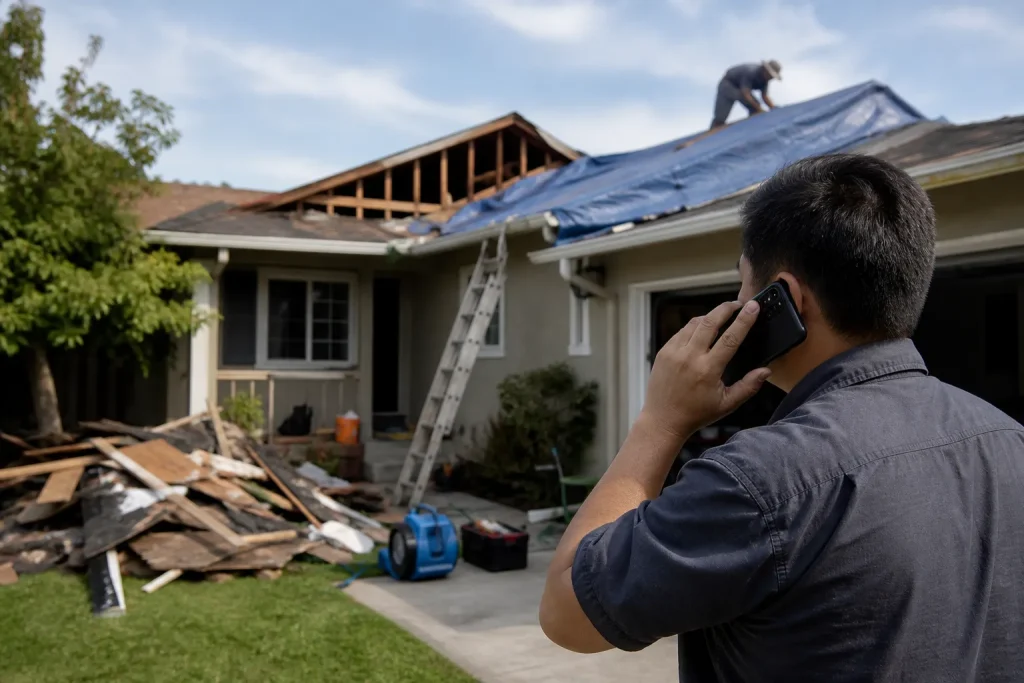
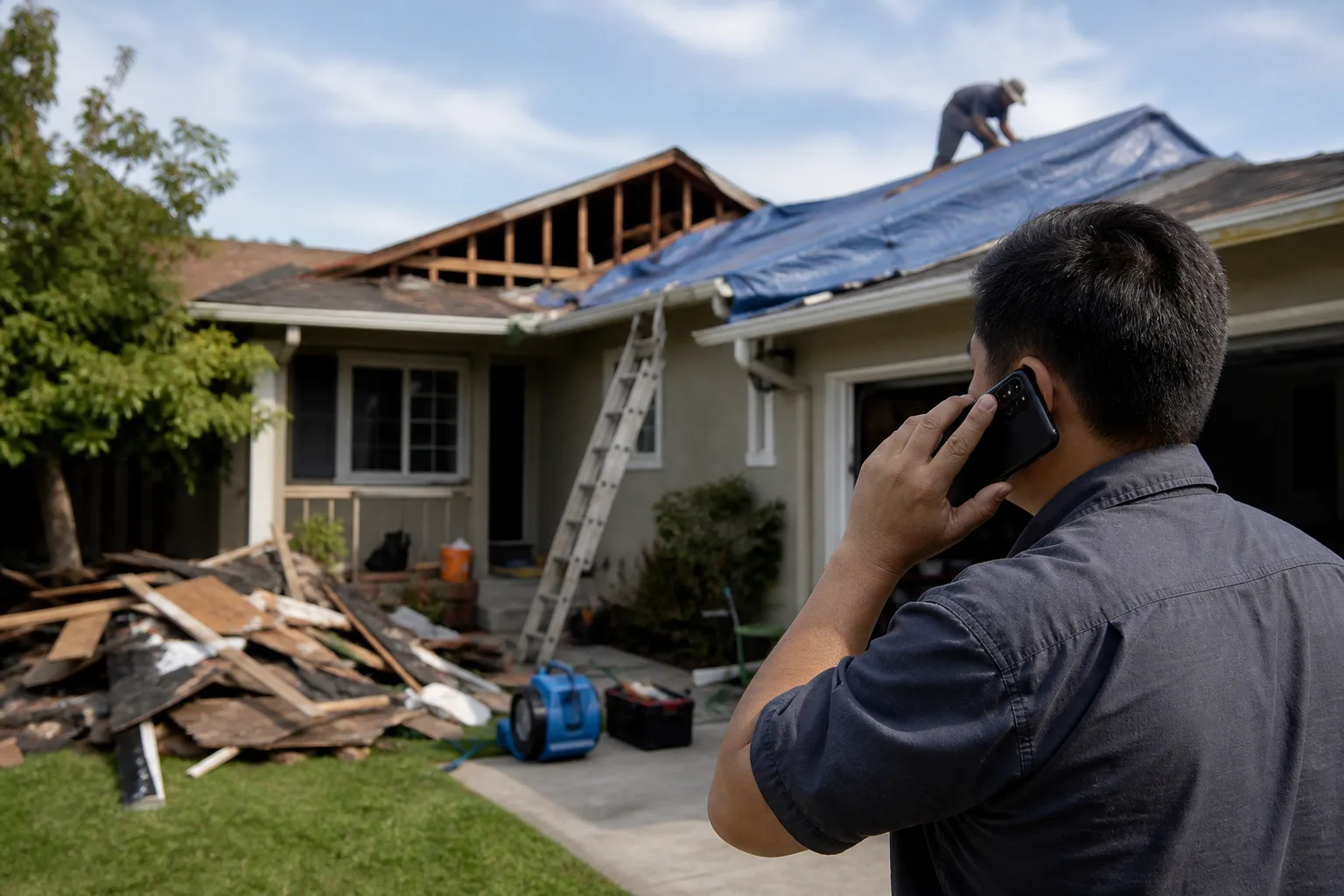
Stabilization means stopping the active damage. Tarping a roof opening. Shutting off the water supply and draining the system. Boarding over a shattered window. Installing temporary shoring if a structural member has failed. This work happens fast, it’s temporary, and it’s priced as an emergency mitigation service. A good contractor will give you a clear number for stabilization before touching anything, then step back.
Full-scope quoting comes after the dust settles. That’s when a contractor walks the entire affected area, looks behind the drywall, checks for hidden water in the wall cavities and subfloor, and builds a line-item estimate for permanent repair. In our experience, any contractor who wants to quote the full renovation while water is still running through your ceiling is guessing. And a guessed estimate becomes a change order later.
Buena Park homes span several decades of construction styles, from post-war ranches near the 91 freeway to newer builds up toward the West Coyote Hills. Each era has its own failure patterns. A 1950s ranch and a 1990s two-story respond differently to water intrusion and wind load. The contractor you choose should be asking questions about your home’s age and construction type before quoting anything.
California’s Right to Cancel: Your Legal Shield in an Emergency
Here’s something storm chasers hope you never learn: California law gives you a three-day right to cancel most home improvement contracts, provided the work hasn’t started and the contract was signed at your home or somewhere other than the contractor’s place of business. Under California Business and Professions Code section 1689.6, if a contractor pressures you into signing a repair contract while you’re standing in a flooded living room, you likely have three business days to rescind it in writing.
There are exceptions. If the emergency is so severe that the contractor has already begun work, or if you specifically request the contractor to begin immediately, the rules shift. That’s precisely why shady operators push so hard for a signature and a start. They know the cancellation window narrows once work begins.
What does this mean for you as a Buena Park homeowner? It means you can sign a contract to stop the bleeding and still have breathing room to evaluate it. Read what you’re signing. Ask for the cancellation notice form, which California requires contractors to provide with any home improvement contract. If they can’t produce it, that’s your answer about who you’re dealing with.
A full-scope general contractor who plans to do the job right will not be threatened by your due diligence. We’re not. The homeowners who read their contracts carefully are usually the ones we want to work with anyway – they care about the details.
Verify the License in Five Minutes: The CSLB Filter
The single most important filter during a Buena Park emergency is the Contractors State License Board database. It takes five minutes and eliminates most of the dangerous players. Here’s the process:
- Go to cslb.ca.gov and click “Check a License.”
- Enter the contractor’s name or license number. Ask for the number on the phone – a licensed contractor knows it by heart.
- Confirm the license classification. For the type of emergency repairs we’re discussing, you want a “B” (General Building Contractor) license. A specialty “C” license limits the contractor to a specific trade.
- Check the status. It should say “Active.” Not “Expired,” not “Suspended.”
- Look at the date the license was first issued. A contractor who has held a license for three weeks and claims to have “years of experience” is telling you something.
- Review any disclosures. The CSLB lists pending judgments, arbitration awards, and disciplinary actions against the license.
We pulled one out of a garage over near Cypress last spring where a homeowner had a so-called contractor detach a load-bearing wall during a “quick fix” that turned a $4,000 repair into a $38,000 rebuild. The contractor’s license was a specialty C-27 landscaping classification. He had no business touching a structural wall, but the homeowner was in shock and didn’t check. Please don’t be that homeowner.
When to Call Your Insurance Adjuster (and What to Say)
The order of operations matters more than most Buena Park homeowners expect. You call your insurance company either before authorizing any work or after the emergency has been stabilized – not after you’ve replaced half your roof.
When you call, use language that protects your claim:
- Say: “We have active water intrusion from storm damage. We’ve photographed everything and we’re requesting guidance on emergency mitigation.”
- Don’t say: “We’re getting the whole thing fixed and sending you the bill.”
- Say: “A licensed contractor has stabilized the opening with a tarp and temporary seal. We’d like to submit those receipts as part of our claim.”
- Don’t say: “We went ahead and hired someone to fix it all.”
Most homeowner policies require you to take reasonable steps to prevent further damage. That’s what stabilization does. What most policies do not cover is the cost of permanent repairs performed before the adjuster has assessed the damage and approved the scope. If you tear out and rebuild before the adjuster documents the scene, you’ve handed your insurance company a reason to deny the claim.
Adjusters also notice the quality of the emergency response. When they see clean documentation, professional mitigation, and a licensed contractor on site, they process claims faster. When they see contradictory stories, missing photos, and work performed by an unlicensed crew, the claim drags and the questions multiply.
What to Expect From a Real Emergency GC Response
When a licensed, full-scope general contractor responds to a Buena Park emergency, the process follows a logical sequence. Here’s what we do on emergency calls, and what you should expect from any legitimate contractor:
First contact: we ask about the source of damage, whether utilities are shut off, whether anyone is injured, and whether you’ve contacted your insurance. We’re gathering information before we even get in the truck.
On site: we do a safety walk. We’re looking for live electrical hazards, gas line involvement, structural compromise, and water migration paths. We won’t enter a space that’s unsafe, and we’ll tell you if we’re seeing something your insurance adjuster needs to know about immediately.
Stabilization quote: separate from everything else. Clear number, clear scope, written on a simple work order so you have documentation for your claim.
Full-scope estimate: scheduled for a later visit, after we’ve had a chance to inspect behind the obvious damage. This is where our brand partnerships actually matter. If your roof sheathing needs replacement, we’re matching the existing system with materials from manufacturers like GAF or CertainTeed. If we’re rebuilding a window opening, we’re looking at PGT for impact-rated options. These are not afterthoughts – they’re part of the structural integrity conversation from day one.
The homeowners who call us before the emergency are the ones who get through it best. They know what questions to ask. They know what documentation matters. They know their legal protections. The emergency still gets handled, but it gets handled without the panic that leads to bad decisions.
The Bottom Line
If you’re staring at a structural emergency in Buena Park, the sequence is simple: document everything, stabilize the damage, verify the contractor’s license, and coordinate with your insurance before authorizing permanent repairs. If you’re not in an emergency but want to be prepared, save the Key Step Construction home number in your phone and review our approach to full-home renovation before you need it.
For emergency stabilization and full-scope repair estimates in Buena Park, our door is open. Call (855) 382-0824 and explain what you’re seeing. We’ll tell you honestly whether you need immediate structural intervention or a scheduled inspection – either way, you’ll get straight answers and a clear number. No pressure, no storm-chaser tactics, just a licensed general contractor who knows how Buena Park homes are built and how to rebuild them right.
Frequently Asked Questions
Emergency stabilization in Buena Park typically runs from $500 to $2,500 depending on the scope, with water mitigation, tarping, and board-up work at the lower end. Full-scope structural repair or water remediation can range from $5,000 to $50,000 or more, depending on how deep the damage goes. Call (855) 382-0824 after you’ve documented the damage and we’ll give you a realistic range for your specific situation.
Most homeowners policies cover the cost of emergency mitigation that prevents further damage, like tarping a roof opening or shutting down a leaking pipe. They do not cover permanent repairs performed before your adjuster has assessed the damage. Call your insurance company first, report the emergency, and ask specifically what they’ll authorize for immediate mitigation.
No. Storm chasers target Buena Park neighborhoods after major weather events, and many carry pre-written contracts designed to lock you in while you’re still shaken. Ask for their CSLB license number, verify it online, and remember that California law gives you a three-day right to cancel most home improvement contracts signed at your home. Legitimate local contractors don’t door-knock after storms.
Most emergency stabilization work, like tarping a roof or boarding a window, can be completed in two to four hours once a contractor arrives on site in Buena Park. Full-scope repair work takes days to weeks, depending on the extent of the damage and what systems need to be rebuilt from general contractor scope. Ask for a clear timeline before authorizing any work.
Yes. Structural repairs, electrical work, plumbing replacement, and roofing beyond basic tarping all require permits through the City of Buena Park. Any contractor who suggests skipping permits on emergency work is setting you up for trouble when you sell the home. We handle permitting as a standard part of our home remodeling in Buena Park and home renovation projects – it’s not an optional add-on, it’s how you protect the investment.
Written by the team at Key Step Construction, serving Buena Park since 2017.
Need Construction Help?
Call Key Step Construction - licensed & insured, with free written estimates in Buena Park.
(855) 382-0824